Tools
Only two games on Steam make you write real code. The rest of the “learn to program” shelf teaches logic with the syntax removed — which is useful, but it is not the same skill. Knowing which tier a game sits in before you buy is the difference between a genuine head start and a very pleasant automation game.
Every price and store claim below was checked against the Steam store API at the time of writing.
The three tiers
| Game | Price | What you actually write | Tier |
|---|---|---|---|
| Code: Terraform | $13.49 | Real scripts that run while you plan | Real code |
| Ghost in the SQL Data | Free | Real SQL queries against a database | Real code |
| Craftomation 101 | $10.49 | Visual code blocks you connect | Logic, no syntax |
| Order Automatica | $4.79 | Placement rules that resolve automatically | Logic, no syntax |
| Dataminers | $6.99 | Nothing — it is a logic puzzle with hacker framing | Aesthetic only |
| Alchemy Factory | $14.39 | Nothing — conveyors, pipes and magical devices | Aesthetic only |
| FEED THE AI | Check store | Nothing — AI as theme, not mechanic | Aesthetic only |
Tier one: you type, and it runs
Code: Terraform
Code: Terraform is the only paid game here where the store page says “write real code” and means it. You script rovers, power grids, fabrication and drone fleets on a frozen alien planet, and — the important part — your scripts keep running while you plan your next move. That detail is what makes it a programming game rather than a puzzle game: your code executes in a world that is still changing, so a script that worked on the state you wrote it for can fail on the state it actually meets.
It is in Early Access at $13.49 from AppsMafia, released 9 September 2026.
Ghost in the SQL Data
Ghost in the SQL Data makes you write actual SQL queries to solve murders. SQL is an unusually good fit for a game, because a query is a complete, self-contained question with a verifiable answer — which is exactly the shape of a detective puzzle. We covered it separately in this write-up.
Tier two: the logic without the typing
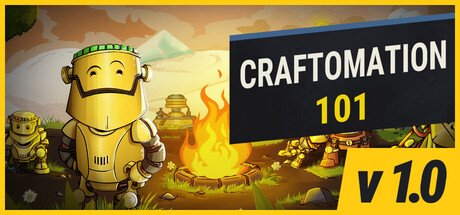
Craftomation 101 from Luden.io is the strongest game on this list by review volume — 662 reviews and a 7.55 score, currently #16 on the Steam 250 week chart. You connect visual blocks to program robots that must produce their own fuel.
Block programming gets dismissed as the children’s version, and that is wrong for a specific reason: removing syntax removes the failure mode that makes beginners quit. A missing semicolon teaches nothing except that programming is hostile. Craftomation’s difficulty is entirely in the logic, which means every hour of frustration is an hour spent on the part that transfers.
What it does not give you is the experience of reading an error message, and that is not a small omission — see below.
Order Automatica at $4.79 belongs here for an odd reason: you set up rules on a 3×3 grid and the battle then resolves itself. That is programming in the loosest sense — specifying behaviour in advance and watching it execute — and at under five dollars it is the cheapest way to feel what automation thinking is like.
Tier three: programming as decor
This is the tier buyers get wrong, and the store pages do not help.
Dataminers from Electrocosmos puts you inside the mind of an ethical hacker, racing a firewall as you clear towers and hack terminals. Its own store page calls it a casual logic game, which is accurate and honest. It is a good $6.99 puzzle game. You will not write a line of anything.
Alchemy Factory is a co-op automation game with conveyor belts, pipes and magical devices, and automation games genuinely do build systems intuition — throughput, bottlenecks, dependency chains. That intuition is real and useful. It is also not programming, and the distinction matters if you are buying with a goal in mind.
Sandustry and FEED THE AI sit in the same category: excellent systems games, technical theming, no code.
The one thing they all get wrong
Every game on this list teaches you to write a program. Not one of them teaches you to fix someone else’s.
The bulk of professional programming is not composition, it is diagnosis: reading code you did not write, forming a hypothesis about why it is behaving badly, and testing that hypothesis under time pressure with incomplete information. Games avoid this because it is miserable to make fun. A puzzle has a designed solution; a bug has a cause, and finding causes is not a puzzle, it is a search.
Code: Terraform comes closest, because a script running against a changing world will fail in ways you did not author. That is the nearest thing to real debugging on the Steam store, and it is still a long way from reading a stack trace in a codebase of 200,000 lines.
So: these games will make you faster at the first week of learning to program. They will not shorten the first year.
What is still unknown
There is no good public evidence on whether programming games produce measurable skill transfer. The claim is plausible — block-based tools are used in real curricula — but we have not found a study that tests whether players of these specific games learn faster afterwards, and we are not going to imply one exists. Treat the tier table as a description of what each game asks of you, not as a ranking of educational outcomes.
Two entries above are also unfinished or unreleased: Code: Terraform is in Early Access, and Ghost in the SQL Data is marked coming soon on its store page, so check its status before planning around it.
Frequently asked questions
What games actually teach you to code?
On Steam, Code: Terraform at 13.49 dollars has you write real scripts, and Ghost in the SQL Data has you write real SQL queries. Craftomation 101 at 10.49 dollars teaches programming logic using visual blocks rather than typed syntax.
Can you really learn programming from a game?
You can learn the logic reliably: sequencing, loops, conditions and dependency thinking all transfer. What games do not teach is debugging unfamiliar code under uncertainty, which is most of the actual job.
Is Craftomation 101 real programming?
It uses visual code blocks, not a written language, so you never type syntax. The concepts are real programming concepts and they transfer, but you are not writing code you could paste into an editor.
What is the best programming game for a complete beginner?
Craftomation 101, because removing syntax errors means every difficulty you hit is a logic problem rather than a typo. Beginners who quit usually quit over error messages, not over concepts.
Are automation games like Alchemy Factory good for learning to code?
They build genuine systems intuition, such as recognising bottlenecks and dependency chains, which helps later. They involve no code at all, so treat them as adjacent training rather than as programming practice.
Is there a free game that teaches SQL?
Ghost in the SQL Data is a detective game built around writing real SQL queries to solve murders. Check its Steam page for current availability, as it is listed as coming soon.
Sources and citation
- Steam store API appdetails endpoint, the source for every price, Early Access status and store description quoted above, retrieved 16 September 2026
https://store.steampowered.com/api/appdetails - Steam 250 seven-day chart, for the Craftomation 101 chart position, score and review count
https://steam250.com/7day - Steam store pages for each listed game, for feature lists and genre tags
https://store.steampowered.com/
Recommended
- This Free Detective Game Makes You Write Real SQL to Solve Murders
- Godot vs Unity vs Unreal: An Honest Comparison for People Actually Choosing
- The Best Steam Tools and Game Discovery Sites (Complete 2026 Directory)
- The Best City Builders on Steam Are the Ones That Will Not Let You Grow
- 11 Best Simulation and Management Games on Steam Right Now
- Incremental Games Are Taking Over Steam (And They Are Getting Strange)
- The 12 Jobs of a Solo Developer (And How to Survive Them)
- 20 Indie Games Under $10 That Are Better Than Most $60 Releases
- 11 Best Turn-Based Tactics Games on Steam (Nine Are Roguelites, and That Fixed the Genre)
- 5 Free Indie Games on Steam That Are Genuinely Worth Playing