Features
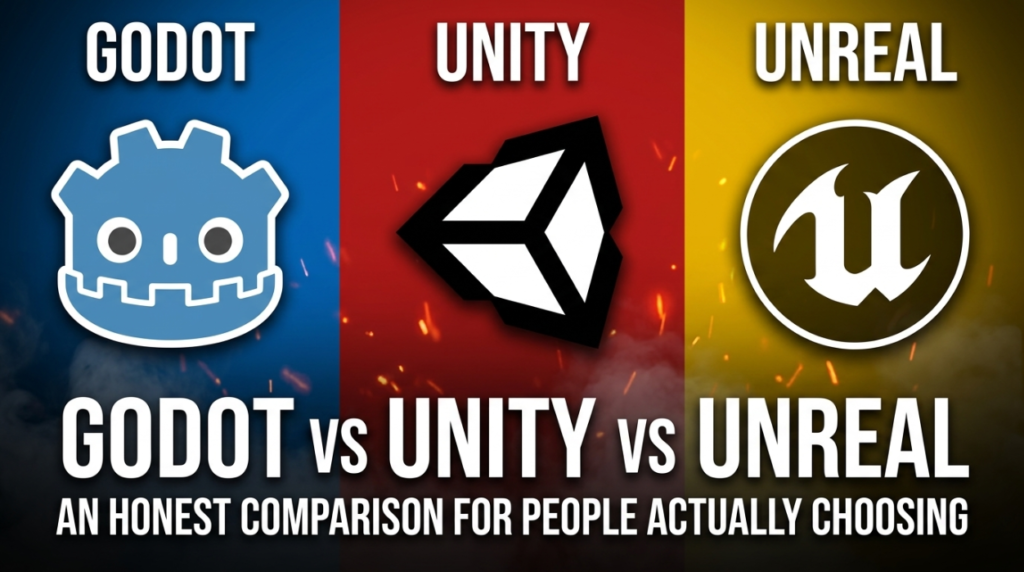
This is the most argued-about question in indie development, and most answers are tribal rather than useful. Here is a practical comparison for someone actually deciding.
Short version: Godot for 2D and small teams, Unity for shipping breadth and hiring, Unreal for high-end 3D. All three are free to start.
Godot
What it is genuinely good at
2D is best-in-class. Godot 2D is not a 3D engine with a flattened camera — it is a separate, purpose-built 2D renderer, and it shows in how naturally 2D projects come together.
It is small and fast. The editor download is tiny, it opens almost instantly, and iteration is quick. On a modest laptop the difference against the alternatives is stark.
It is genuinely free and open source. MIT licensed. No revenue share, no royalties, no seat fees, no licence terms that can change under you. For a lot of developers, that last point became the entire argument.
Nodes and scenes are intuitive. The architecture — everything is a node, every scene is reusable — tends to click faster for beginners than component systems do.
The honest drawbacks
3D is capable but behind. Godot 4 improved 3D enormously, but for large, high-fidelity 3D projects the tooling and optimisation path is less mature.
Fewer assets and fewer answers. Unity has a decade more Stack Overflow posts, tutorials and marketplace assets. When you hit an obscure problem in Godot, you are more likely to be solving it yourself.
Console porting is harder. Because of licensing constraints, console support typically means going through a third-party porting house rather than clicking a build target.
Unity
What it is genuinely good at
It ships everywhere. Mobile, console, desktop, VR — Unity multiplatform pipeline remains the most complete and the most proven.
The ecosystem is enormous. The Asset Store, the tutorial volume, and the sheer number of people who have already solved your problem are real, measurable time savings.
It is the industry hiring standard. If you want a studio job, Unity experience appears in more listings than anything except Unreal. That matters if this is a career and not just a project.
Mobile is a genuine strength, and remains the clearest reason to pick it over Godot.
The honest drawbacks
Trust took a real hit. The 2023 install-fee proposal was walked back, but it demonstrated that licence terms on a proprietary engine can change. A significant number of developers moved to Godot specifically because of it and have not moved back.
It is heavier. Larger install, slower editor, more configuration before you are making anything.
2D is workable, not exceptional. It has improved, but Godot 2D workflow is cleaner.
Unreal Engine
What it is genuinely good at
High-end 3D visuals, without argument. If your game needs to look photoreal, Unreal gets you there faster than anything else, with lighting and rendering technology the others are still catching up to.
Blueprints are a real advantage. Visual scripting that is genuinely production-viable, not a toy, letting designers build systems without writing C++.
Free until you earn. No cost until your product passes a substantial revenue threshold, at which point a royalty applies.
The honest drawbacks
It is enormous. Huge install, heavy hardware demands, long build times. Prototyping is slower simply because everything takes longer.
C++ is a real barrier once you outgrow Blueprints.
Overkill for 2D and small projects. Using Unreal for a pixel-art game is like renting a lorry for a grocery run.
How to actually choose
Making a 2D game?
Godot. Faster to build in, better suited to the job, and nothing about the licence can change on you later.
Making a mobile game?
Unity. The pipeline, the ad and analytics integrations, and the deployment story are all more mature.
Making a photoreal 3D game?
Unreal. Not close.
Working alone, on a modest machine, learning?
Godot. Fast iteration compounds, and on a small project it matters more than raw capability.
Want a studio job?
Unity or Unreal. Godot is growing quickly but is still rarer in job listings.
Worried about licence changes?
Godot. It is the only one of the three where that risk does not exist at all.
The thing nobody says out loud
Engine choice matters far less than finishing. Every engine here can ship a hit, and every one has shipped several. The games that break out do so because of a distinctive idea executed thoroughly — How to Fish hit 340,000 concurrent players on a mechanic, not a renderer.
Pick the one you will actually open tomorrow. That is the real criterion.
See our Godot shader breakdown and our directory of developer tools.
Frequently asked questions
Is Godot better than Unity?
For 2D games, small teams and fast iteration, Godot is generally better. Unity is stronger for mobile, console deployment, asset ecosystem and employability. Neither is universally better.
Is Godot completely free?
Yes. Godot is MIT licensed open source with no revenue share, royalties or seat fees, and the licence terms cannot be changed retroactively.
Why did developers move from Unity to Godot?
The 2023 install-fee proposal, later reversed, demonstrated that licence terms on a proprietary engine can change unexpectedly. Many developers moved to Godot for the certainty of an open-source licence.
Should I use Unreal Engine for a 2D game?
Generally no. Unreal strengths are high-end 3D rendering, and its size and build times make it heavy for 2D or small projects where Godot or Unity iterate faster.
Which engine is best for beginners?
Godot for 2D, thanks to its small download, fast editor and intuitive node system. Unity if you want the largest volume of tutorials and the strongest path to employment.
New reads this week
Published 20 September 2026 on IndieForGames.