Features
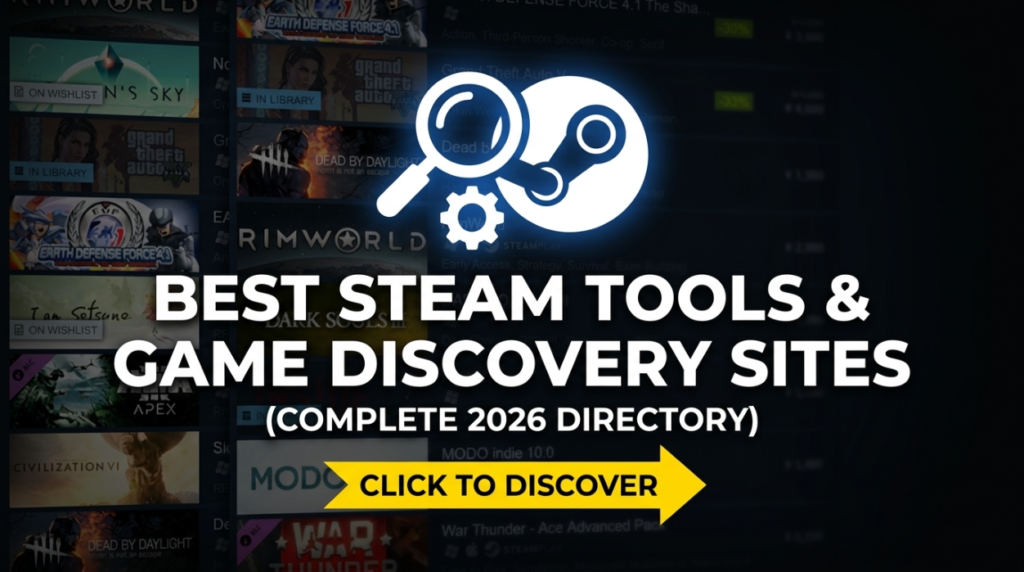
If you want to find good games, track prices, or understand how the Steam market actually behaves, the store itself is one of the least useful tools available. The genuinely valuable resources are built by third parties — and most people only know one or two of them.
This is a working directory of the sites we use, organised by what you are actually trying to do. Every entry is free to use unless noted.
Steam data and statistics
SteamDB
The single most useful Steam tool that exists. SteamDB tracks price history, concurrent player counts, review breakdowns, depot changes, and unannounced app updates. If you want to know whether a discount is genuinely the lowest a game has ever been, or how many people are actually playing something right now, this is where you check.
Best for: price history, live player counts, spotting updates before they are announced.
Steam Charts
Concurrent player tracking with clean historical graphs going back years. Narrower than SteamDB but faster to read when all you want is a player-count trend over time.
Best for: long-term player retention at a glance.
Steam 250
Rankings built from review scores weighted against review volume, which is a far better signal than raw percentage. Includes weekly, monthly, quarterly and yearly charts, a Hidden Gems list, tag-based rankings, and price-bracket filters.
Best for: finding good games that never reached the Steam front page.
SteamSpy
Ownership and player estimates. Less precise since Valve restricted public data, but still useful for rough scale comparisons between titles.
Best for: ballpark ownership figures.
Steam Hunters
Achievement statistics and completion difficulty across the Steam catalogue.
Best for: completionists judging how brutal a 100% run will be.
Prices, deals and key comparison
IsThereAnyDeal
The best price-comparison tool for PC games. Compares current prices across dozens of authorised stores, shows historical lows, and lets you set price alerts on a wishlist. Crucially, it tells you whether today deal is actually good or just loud.
Best for: knowing the real historical low before you buy.
GG.deals
Price comparison covering both official stores and key resellers, with a clear split between the two so you know what you are buying.
Best for: comparing official versus key-reseller pricing.
DLCompare
Key and game price comparison across storefronts, with an active gaming news section attached.
Best for: cross-store price checks plus news in one place.
SteamDB Sales
Every active Steam discount, sortable and filterable in ways the Steam store simply does not allow.
Best for: actually navigating a Steam sale.
Game discovery
itch.io
The largest home for experimental, free, and small-scale indie games outside Steam. Game jams, prototypes, and a lot of work that would never survive Steam discoverability.
Best for: finding things that do not exist anywhere else.
IndieDB
Long-running indie database with developer-posted devlogs, alpha builds, and release tracking.
Best for: following games through development rather than at launch.
Steam Next Fest
Valve demo festival, running three times a year in February, June and October. The best single window for trying unreleased games.
Best for: playing demos before wishlisting.
Backloggd
A Letterboxd-style logging and review site for games. Useful for discovery through people whose taste you trust rather than through algorithms.
Best for: human curation.
OpenCritic
Aggregated critic reviews with a transparent methodology and no publisher-facing score licensing.
Best for: critical consensus on bigger releases.
Resources for developers
Steamworks Documentation
Valve official documentation. Genuinely worth reading directly rather than through secondhand summaries — the rules on discount cooldowns, wishlist notification thresholds, festival eligibility and visibility rounds are all specified here.
Best for: the actual rules, from the source.
How To Market A Game
Chris Zukowski blog, and the most consistently data-driven writing on indie game marketing available for free. Wishlist benchmarks, genre analysis, and festival performance breakdowns.
Best for: marketing decisions grounded in numbers.
GameDiscoverCo
Simon Carless newsletter on game discoverability and platform economics. Weekly analysis of what is actually selling and why.
Best for: understanding platform dynamics.
Video Game Insights
Steam market analytics with revenue estimates, genre performance data, and publisher comparisons. Free tier is limited but useful.
Best for: genre and revenue benchmarking.
Gamalytic
Steam sales and revenue estimation with genre breakdowns and wishlist-to-sales modelling.
Best for: estimating what a game actually earned.
Godot and Godot Shaders
The open-source engine and its community shader library, where a large amount of free, reusable graphics work gets shared.
Best for: free engine and free shaders.
Communities worth reading
- r/gameDevMarketing — developers sharing real campaign results, including failures
- r/IndieDev — development discussion and feedback
- r/indiegames — player-facing indie discovery
- r/godot — the most active engine-specific community for indie devs
How we actually use these
Before buying a game
Check IsThereAnyDeal for the historical low, then SteamDB for current player count. A game with a big discount and no players is a different proposition to a game with a small discount and a healthy community.
To find something new
Steam 250 weekly and monthly charts, filtered mentally for anything under $15. Review-weighted rankings surface things the store never will.
To judge whether a game is dying
Steam Charts for the long-term trend, not the current number. A game at 2,000 players that was at 2,200 last year is healthy. One at 2,000 that was at 40,000 is not.
If you are making a game
Steamworks docs for the rules, How To Market A Game for benchmarks, Gamalytic or VG Insights for genre reality checks.
Frequently asked questions
What is the best website for Steam statistics?
SteamDB is the most comprehensive, covering price history, concurrent players, review breakdowns and app updates. Steam Charts is simpler and faster if you only need player-count trends over time.
How do I know if a Steam sale price is actually good?
Check IsThereAnyDeal or SteamDB for the historical low. Seasonal Steam sales usually match a game best previous discount but do not always beat it, so a large percentage banner does not guarantee the best price.
What is the best site for finding hidden indie games?
Steam 250 ranks games by review score weighted against review volume, which surfaces well-regarded games that never got front-page placement. Its Hidden Gems list is built specifically for this. itch.io is the best source for experimental work that is not on Steam at all.
What tools should indie developers use for market research?
Steamworks documentation for platform rules, How To Market A Game for data-driven marketing benchmarks, and Gamalytic or Video Game Insights for revenue and genre estimates. GameDiscoverCo covers platform discoverability weekly.
Are these tools free?
SteamDB, Steam Charts, Steam 250, SteamSpy, IsThereAnyDeal, GG.deals, itch.io, IndieDB, Backloggd and OpenCritic are all free to use. Analytics platforms such as Gamalytic and Video Game Insights offer limited free tiers with paid plans for full data.
For more developer material, see our resources library, or browse the games library.
New reads this week
Published 20 September 2026 on IndieForGames.