Features
The interesting roguelike deckbuilders on Steam right now are the ones that removed a card. Not added mechanics on top of Slay the Spire — removed something load-bearing and replaced it with dice, tiles, a second deck, or nothing at all. That is the pattern worth following, and it explains why the genre keeps producing hits nine years after it was supposedly solved.
Below are eight on Steam that each break the formula in a different place. It is a short list on purpose. There are hundreds of deckbuilders; there are not hundreds doing anything new.
The argument: the deck stopped being the genre
A deckbuilder used to mean a specific loop — draw a hand, spend energy, discard, reshuffle, add a card after the fight. For a few years that loop was the game.
What happened since is that developers noticed the loop is not really about cards. It is a way of making randomness feel like planning: you choose what goes into a pool, the pool decides what you get, and the gap between those two is where the interest lives. Once you state it that way, the cards are optional. Any randomiser you can edit works — dice, tiles, a shop inventory, a board.
So the genre started absorbing other games the way roguelikes did a decade earlier. The games below are the clearest examples.
Eight that changed something structural
Grail — removes playing cards entirely
A deckbuilder where you never play a card. The deck plays itself and you only build it. This is the purest possible statement of the thesis above: strip out the moment-to-moment hand management and what remains is still a deckbuilder, because the interesting decision was always the construction, not the draw. $7.99.
Ribbit Rogue — the deck is made of dice
Turn-based, deck-building, and every card is a die with six faces carrying their own actions. Pairing faces with relics found during a run builds the equivalent of a card combo. Swapping cards for dice adds a second layer of randomness inside each draw, which makes a strong deck less deterministic and a weak one less hopeless. $7.99.
Dice Tavern: Farkle Roguelike — the deck is a pub game from the 14th century
Built on the rules of Farkle, with 35 dice and 43 synergies across six taverns and thirty opponents. Using an existing push-your-luck game as the combat system means the developer inherits a balanced core and spends their effort on the synergy layer, which is the part players actually replay for. $7.99.
Shroom and Gloom — two decks instead of one
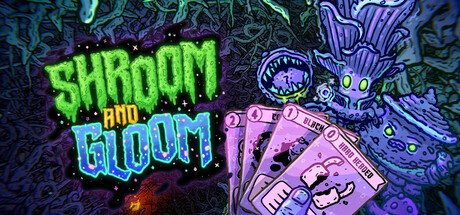
A first-person roguelike double deckbuilder from Team Lazerbeam, published by Devolver Digital, entering Early Access on 10 September 2026. You build an attack deck and an exploration deck separately, and you eat the mushroom enemies you defeat. Splitting the decks fixes the genre’s most common unrecoverable state — a bad combat draw that also strands you.
Dialoop — the deck feeds a match-3 board
A roguelite puzzle hybrid fusing deckbuilding, match-3 and exploration. You manipulate stone tablets and strengthen your deck to hit each stage target score. Match-3 already has a randomiser you cannot control; letting the player edit it is the whole idea, and it is a more natural fit than it sounds.
Vampire Crawlers — horde survival, resolved with cards
A turn-based, card-driven dungeon crawler with roguelite elements from poncle, the BAFTA-winning Vampire Survivors studio, co-developed with Nosebleed Interactive. It is the reverse direction of everything else here — a studio that made its name on real-time hordes converting that pressure into turn-based card play. $7.99.
Dreamcards — the deck is built at a different time of day than it is used
Combine six strategies during the day, then build your deck at night while facing the nightmare. Separating construction and combat into distinct phases makes deckbuilding a deliberate planning session instead of a between-fight reward screen.
A game about cards — everything is a card, including the save file
Craft weapon cards, slay monster cards, build combos out of cards. The save file is a card too. It is the joke taken to its logical end, and the reason it works is that it commits: once every noun in the game is the same object, combos stop being a subsystem and become the whole interface.
What this list is not good for
None of these will scratch the itch if what you actually want is more Slay the Spire. They are interesting because they deviate, and deviation costs polish. Several are small releases with review counts in the low hundreds, and one is not out yet at the time of writing.
If you want the safe recommendation, the genre’s canonical entries are canonical for good reasons and you do not need us to name them. This list is for the second purchase, not the first.
The other honest caveat: “removes a card” is a design distinction, not a quality guarantee. A clever structural idea and a shallow synergy pool produce a game you finish in one evening. Check the review count and the Steam tags before buying on premise alone.
Frequently asked questions
What is a roguelike deckbuilder?
A game that combines run-based roguelike structure with deck construction: you start each run with a basic deck, add and remove cards as you progress, and lose the deck when the run ends.
What is a double deckbuilder?
A deckbuilder with two separate decks drawn from independently. Shroom and Gloom uses one for combat and one for exploration, so a bad draw in one does not compromise the other.
Are there deckbuilders without cards?
Yes. Ribbit Rogue builds its deck out of dice, Dice Tavern uses Farkle dice rules, and Dialoop feeds a match-3 board. Grail keeps cards but removes the act of playing them.
What is the cheapest roguelike deckbuilder on Steam?
Several of the games here sit at 7.99 dollars, including Grail, Ribbit Rogue, Dice Tavern: Farkle Roguelike and Vampire Crawlers. Prices change during Steam sales.
Is Vampire Crawlers made by the Vampire Survivors developer?
Yes. It is from poncle, the studio behind Vampire Survivors, co-developed with Nosebleed Interactive.
When does Shroom and Gloom release?
It enters Steam Early Access on 10 September 2026, published by Devolver Digital.
Recommended
- New Roguelike Games on Steam
- Best Action Roguelikes on Steam
- Games Like Vampire Survivors
- Why Indie Strategy Games Are All Roguelikes Now
- Best Indie Trading Games on Steam
- Best Autobattler Games on Steam
- Best Cheap Indie Games Under $10
- Best Short Games on Steam
- Best Incremental Games on Steam
- Highest Rated Indie Games on Steam
Added this week (12 September 2026)
- The Loopler — the deck scores by lap rather than by combat, and gate placement order decides which effects fire first. New entry at #19 on Steam 250, 95% positive from 101 reviews, .99.
New reads this week
Published 16 September 2026 on IndieForGames.