Features
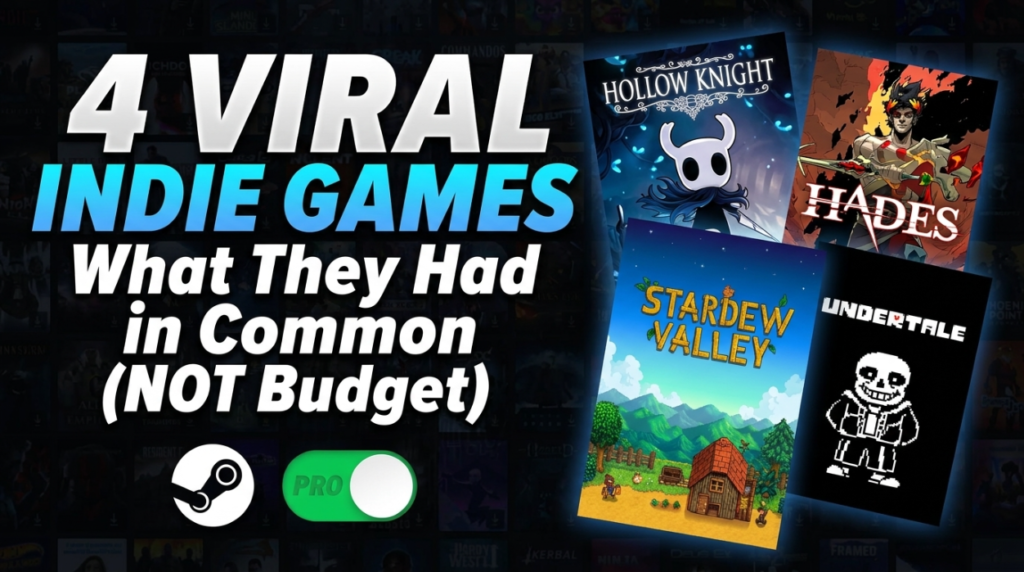
Over the past month we have tracked several indie games that broke out unexpectedly. None of them had a marketing budget worth mentioning. Two were made by fewer than three people.
The pattern between them is consistent enough to be worth writing down properly, because it is not the one most developers expect.
The four cases
How to Fish — 340,000 concurrent players
Two Swedish programmers, Carl-Vilhelm Johansson and Melvin Olsson, released a $4.95 physics fishing game on August 20, 2026. Within three days it peaked at 142,000 concurrent players. It has since surpassed 340,000.
The hook: you fling a caught fish into the air with your rod, then shoot it mid-flight with a rifle for bonus money. The game actively rewards showing off rather than fishing efficiently.
Leaf it Alone — viral ten months after launch
Released October 30, 2025 at $5.99. Nothing much happened.
In August 2026, searches for “a game about picking up leaves” went breakout on Google Trends, up 4,800%. Short-form creators had found it. One TikTok alone reached 165,600 likes.
The game is about clearing a yard buried in leaves, starting by hand and upgrading to a leaf blower.
Ylem’s Cat — 1.9 million views before release
A Japanese Steam curator posted about an unreleased game. The post reached 1.9 million views, 35,000 likes and 9,600 reposts.
The opening line, translated: “You can ride on the back of a giant kitty.”
The second line: “Screw all the complicated lore and stuff, I don’t care anymore.”
10,000 wishlists in two weeks, $0 spent
A solo developer building a cozy game about tidying a sleeping dragon hoard hit 10,000 Steam wishlists in two weeks with no advertising. One Instagram Reel reached 355,000 views. A TikTok reached 106,000. A creator picked it up independently for another 109,000.
At peak they were adding 1,000 to 1,500 wishlists per day.
What they actually have in common
1. One verb you can picture
Not a genre. Not a feature list. A single thing you do.
Shoot the fish. Clear the leaves. Ride the cat. Dig the hole.
Every one of these survives being repeated by a stranger to a friend the next day, which is the actual distribution mechanism. A pitch that requires a paragraph does not travel.
2. They resemble content people already watch for non-gaming reasons
This is the least obvious point and probably the most important.
Leaf it Alone looks like power-washing and cleaning videos — one of the largest categories on short-form video, watched daily by millions of people with no interest in games at all.
The solo developer above said it directly: cleaning content is already enormous, so nobody had to be convinced that watching mess become order is satisfying. That was true before the game existed. The game walked into an audience rather than building one.
The generalisable version: if your game resembles an existing non-gaming content behaviour, that is worth more than any amount of posting discipline.
3. The transformation is visible in seconds
Most incremental games show progress as numbers rising in a menu. These show it physically.
A buried yard becoming a clear yard reads instantly in a ten-second clip. The difference between hand-picking leaves and a fully upgraded blower compresses hours of progression into something watchable.
If your progression is invisible, it cannot be clipped.
4. First-second retention decides everything
The wishlist case study is precise about this. Their Reel managed 600 views in 12 hours initially — a flop by any measure. Then it climbed in waves to 355,000.
The metric that drove it was 72% first-second retention. The TikTok that later went viral hit roughly 70%.
Not length. Not hashtags. Not posting cadence. Whether people are still watching one second in.
5. The hook is usually buried on the store page
This is the painful one, and it is close to universal.
Ylem’s Cat opens its Steam description with a dying planet, silent giants, Sentinels and a missing mother. That is atmospheric, coherent writing. It is also not why 1.9 million people looked at the game.
Developers bury the hook because to them it feels obvious, or because it feels like a spoiler. To a stranger, it is the only reason to keep reading.
The test
Can a stranger repeat your pitch to a friend tomorrow?
Nobody repeats “an action-adventure driven by the bond between a girl and her cat, set on a dying planet.” Everybody repeats “you ride a giant cat and steer it with a laser pointer.”
Both describe the same game. Only one of them travels.
Three things this does not mean
It does not mean delete your lore
Keep it. The dying planet and the silent giants are what make Ylem’s Cat worth finishing. They are simply not what makes someone stop scrolling.
Lead with the hook. Deliver the depth after.
It does not mean launch week is your only window
Leaf it Alone went viral ten months after release. Most developers treat launch as the entire opportunity, then stop. If your game is inherently watchable, it stays watchable, and creators find things late all the time.
It does not mean this is repeatable on demand
The wishlist developer is explicit that follow-up videos could not reproduce the result, and that a creator picking up the game independently was not something they engineered.
Their read: finding the right concept and implementing it well makes marketing dramatically easier. The videos did not manufacture demand. They revealed it.
The practical checklist
- Identify the single most describable thing in your game
- Check whether it resembles content people already watch for non-gaming reasons
- Put it in the first line of your store page, not the last
- Make sure your progression is visually legible in under ten seconds
- Optimise clips for the first second, not the whole clip
- Get your Steam page live before any video push — the traffic wave does not come back
- Keep posting after launch. The window is longer than you think
Frequently asked questions
How do indie games go viral without marketing budgets?
The consistent pattern is a single visually describable mechanic that resembles content people already watch for non-gaming reasons, combined with progression that is visible within seconds. Clips then do the distribution rather than paid promotion.
What is the most important metric for game marketing videos?
First-second retention. One documented case saw a Reel reach 355,000 views on 72% first-second retention, and a TikTok go viral at around 70%. It matters more than length, hashtags or posting frequency.
Should my Steam page be live before I post marketing videos?
Yes, always. Viral traffic arrives in a single wave and disappears. If the Steam page is not live when a video lands, that audience cannot wishlist and will not return.
Can a game go viral after launch?
Yes. Leaf it Alone released in October 2025 and went viral in August 2026, roughly ten months later, when short-form creators found it. Launch week is not the only opportunity.
What should go first in a Steam description?
The single most describable, visual thing your game does. Developers frequently bury this because it feels obvious to them, but to a stranger it is the only reason to keep reading.
More developer resources in our directory of Steam and indie tools, and our guide to how itch.io actually works.
New reads this week
Published 18 September 2026 on IndieForGames.