Features
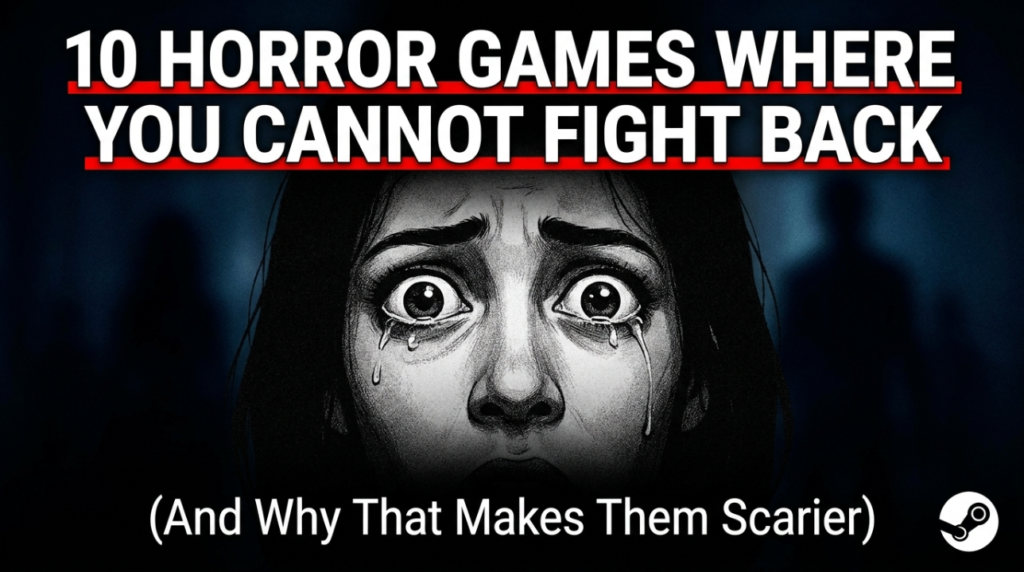
The scariest indie horror games on Steam right now are the ones that never give you a weapon. Not because fighting back is unrealistic, but because combat is the mechanism by which horror games stop being frightening — and removing it is the only reliable fix anyone has found.
Here is the argument, then ten games that prove it.
Why combat kills fear
Give a player a weapon and you give them a project. Within an hour they are no longer afraid of the monster; they are learning it — its patrol route, its tell before it lunges, the range at which the shotgun connects. This is not a failure of the player. It is what players are for. Games train mastery, and mastery is the opposite of dread.
Every combat horror game therefore fights its own systems. Resident Evil manages it by making ammunition scarce enough that fighting stays a bad idea. Most games with smaller budgets cannot afford that balancing act, so their monsters become target practice by the second act.
Take the weapon away and the problem dissolves. There is no encounter to optimise, no build to perfect, no point at which the threat becomes a resource. Whatever is in the building on hour three is exactly as dangerous as it was on minute one.
There is a second, less romantic reason this subgenre is thriving: combat is the single most expensive thing a small team can build. Enemy AI, hit reactions, animation sets, weapon feel, difficulty balance — each is a specialism, and doing any of them badly is worse than not doing them. A solo developer who cuts combat is not just making a design choice. They are redirecting their entire budget into the two things that actually generate fear, which are sound and pacing.
Ten horror games where you cannot fight back
Liminal Shroud
The purest example on this list, and the most explicit about it: no monsters at all, let alone combat. You navigate handcrafted surreal spaces and assemble a mystery from what you find. Reviewers and streamers have singled out the sound design, which is the load-bearing element once you remove every other source of threat. $11.69 at the time of writing.
Serve Or Die
You work the night shift alone in a sandwich shop. The horror is that you have a job to do while something is going wrong in the room, and the two demand the same attention. Some customers act normal. Some know more than they should. $3.49 at the time of writing.
Can I Come In?
Your parents have left, you are home alone, and the rule is simple: do not open the door. An entire horror game built on the one action you must not take is about as economical as the form gets.
Dreadwoods Gatekeeper
Daily duties at an isolated outpost — inspect the trading wagons, patrol the grounds, maintain the station. The dread accumulates through routine, which is the trick this whole category runs on: you notice something is wrong because you know what right looks like.
Hotel Is Hungry
The world ended and you got a hotel job. Check guests in, serve their orders, feed the hotel before it decides to feed itself. One wrong room and someone dies — a failure state that costs you a person rather than health.
Meowmories
You are a cat in a nightmare, looking for your owner. You learn enemy positions and escape routes through repeated failure, which is the no-combat equivalent of levelling up: the only thing that gets stronger is your knowledge.
Martha’s Dolls 2
An urban explorer inside a decaying estate where the porcelain is hunting you. Returns to the house from the first chapter with new rooms and crawlspaces, which works precisely because you think you know the layout. $3.39 at the time of writing.
Don’t Drop The Cake
Balance a cake that wobbles with every step while escaping twisted beings and traps. Occupying the player’s hands with a fragile object is an old stage trick and it still works: you cannot defend yourself because you are busy not dropping something.
Endacopia
A point-and-click adventure styled after early computer edutainment, following a boy who has lost all his senses. The cheerful presentation is the delivery mechanism, and the absence of any way to act violently is what keeps it from resolving into a normal game.
Doki Doki Literature Club!
The most famous entry here and still the clearest proof of the thesis: a free visual novel with no mechanics beyond reading and choosing, which is more unsettling than most games with a full arsenal. Free.
What this subgenre is not good for
Three honest limits.
Most of these are short. Two to four hours is typical, and several are under two. That is appropriate — sustained dread does not survive a twenty-hour runtime — but if you measure value in hours per dollar you will feel short-changed, even at these prices.
Powerlessness is not universally enjoyable. Some players want the arc where the victim becomes dangerous, and no-combat horror never delivers it. If the appeal of horror for you is earning the upper hand, this entire category will read as frustrating rather than frightening.
The formula is being copied badly. “No combat” has become a marketing bullet, and plenty of games use it to describe a walking simulator with a jumpscare at the end. The ones worth your time replace combat with something — a job, a rule, a fragile object — rather than simply removing it and leaving a corridor.
Frequently asked questions
What are the best horror games with no combat?
Liminal Shroud, Serve Or Die, Can I Come In?, Dreadwoods Gatekeeper, Hotel Is Hungry, Meowmories, Martha’s Dolls 2, Don’t Drop The Cake, Endacopia and Doki Doki Literature Club are all built without player combat.
Why do horror games without combat feel scarier?
Because combat lets players convert fear into mastery. Once you can learn and beat a monster it stops being frightening. With no weapon there is no encounter to optimise, so the threat stays as dangerous at the end as it was at the start.
Are no-combat horror games short?
Usually. Two to four hours is common and several are shorter. Sustained dread is difficult to maintain across a long runtime, which is why these games are typically priced between three and twelve dollars.
Is Doki Doki Literature Club free?
Yes. The original is free on Steam and remains one of the highest-rated free games on the platform.
What is the cheapest no-combat horror game on Steam?
Of the games listed here, Doki Doki Literature Club is free, and Martha’s Dolls 2 at 3.39 dollars and Serve Or Die at 3.49 dollars were the cheapest paid entries at the time of writing.
Do no-combat horror games still have jumpscares?
Some do, but the better ones rely on sound design, pacing and routine rather than sudden shocks. A game that removes combat only to lean entirely on jumpscares has not replaced the missing system with anything.
Recommended
- Best Indie Horror Games on Steam
- Asymmetrical Horror Games on Steam
- Best Short Games on Steam
- Best Cheap Indie Games Under $10
- Best Free Indie Games on Steam
- SILENT BREATH
- Twisted Tower
- Mutter
- Tales of Fear – Episode Zero
- Highest Rated Indie Games on Steam
New on the Steam 250 seven-day chart
Added the week of 16 September 2026, verified against the Steam 250 seven-day chart and the Steam store API.