Features
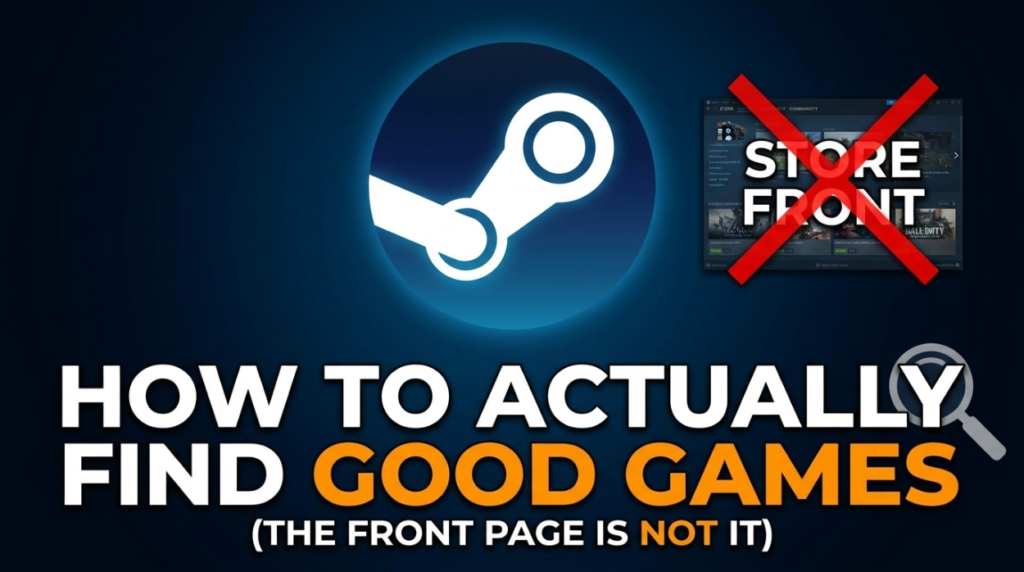
Steam adds thousands of games a year. The store front page shows you a fraction of them, weighted heavily toward whatever is already selling. Almost everything good is somewhere else.
Here is how to actually find it.
1. Stop using the front page
Steam front-page placement skews toward the top 10 to 20% of best-selling titles. It is a sales surface, not a discovery one. If a game is not already succeeding, you will not see it there.
The genuinely interesting releases live in genre tags, curator lists and themed fests.
2. Use review-weighted rankings, not raw scores
A 100% rating on 40 reviews means almost nothing. A 95% rating on 24,000 means the game survived contact with a real audience.
Steam 250 ranks by score weighted against volume, which is why it surfaces well-regarded games that never got front-page placement. Its weekly, monthly and yearly charts are the single best discovery tool available.
3. Check the price history before buying
A large discount banner does not mean a good price. IsThereAnyDeal and SteamDB both show historical lows, so you can tell whether today deal is genuinely the best it has been.
Seasonal Steam sales usually match a game best previous discount, but not always.
4. Read the player count trend, not the number
This is where most people go wrong. A game at 2,000 concurrent players that was at 2,200 a year ago is healthy. One at 2,000 that was at 40,000 last month is not.
Also, a 2,000-concurrent single-player indie game is thriving, while a competitive shooter at the same number cannot fill lobbies. Our full guide to reading Steam player counts covers why the raw figure misleads.
5. Wishlist aggressively
Any discount of 20% or more triggers an automatic email to everyone with the game wishlisted. Build the list, then let Steam tell you when to buy rather than checking manually.
Wishlisting also helps the developer, since wishlist counts affect Steam visibility.
6. Play demos during Next Fest
Steam Next Fest runs three times a year in February, June and October. It is the single best window for trying unreleased games, and demos tell you in fifteen minutes what a trailer cannot.
7. Look outside Steam
itch.io has no approval process, which means no gatekeeping and no curation. Vampire Survivors launched there before Steam. Browsing by game jam is the best approach, because everything in a jam was made to the same brief in the same window.
See our itch.io guide for how bundles work.
8. Trust description over genre
The best filter for indie games is whether the developer can describe the game in one specific sentence.
“A charming cozy pixel-art adventure” describes thousands of games and tells you nothing. “You ride a giant cat and steer it with a laser pointer” describes exactly one.
Games with a describable hook tend to be games where somebody had an actual idea. That is not a guarantee of quality, but it is a much better signal than genre tags.
The tools, in one place
- Steam 250 — review-weighted rankings and hidden gems
- SteamDB — price history, player counts, review breakdowns
- IsThereAnyDeal — historical lows and price alerts
- Steam Charts — long-term player trends
- itch.io — everything that never reached Steam
Full details in our directory of Steam tools and discovery sites.
Frequently asked questions
How do I find good indie games on Steam?
Avoid the front page, which is weighted toward existing best-sellers. Use review-weighted rankings such as Steam 250, browse by genre tag sorted by review score, and play demos during Steam Next Fest in February, June and October.
How do I know if a Steam deal is actually good?
Check the historical low on IsThereAnyDeal or SteamDB. Seasonal sales usually match a game best previous discount but do not always beat it, so a large percentage banner is not proof of a good price.
Is a low player count a bad sign?
Not usually. What matters is the trend over time and whether the game needs a large concurrent population to function. A single-player game at a few thousand concurrents is performing well.
When is Steam Next Fest?
Three times a year, in February, June and October. It is a demo festival rather than a sale.
New reads this week
Published 18 September 2026 on IndieForGames.