Features
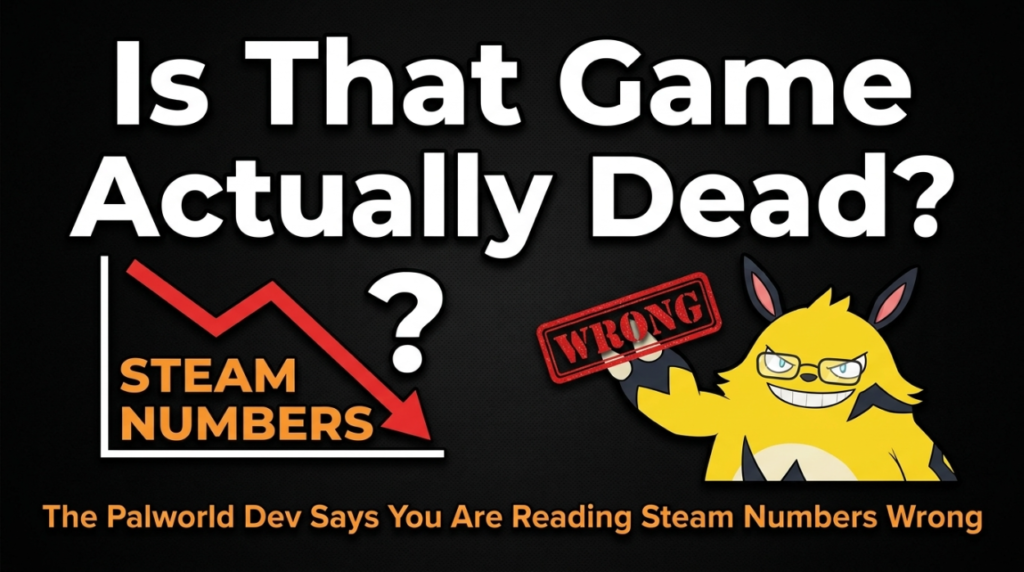
Short answer: almost certainly not. A game losing most of its launch players is normal, expected, and not evidence of failure — and the person making that argument is the one whose game just hit nearly a million concurrent players.
Speaking at Gamescom 2026, Pocketpair publishing lead John Buckley argued that the growing obsession with Steam player counts has misled a lot of people. Here is his case, and why the numbers support it.
Why Steam numbers get weaponised
Buckley makes a structural point that explains the whole phenomenon: Steam is both the dominant PC platform and the only major one that shares live, granular player data.
Consoles do not publish concurrent players. Game Pass does not. The Epic Games Store does not. So Steam concurrents become the only public number available, and a number that is public becomes the number everyone uses — as, in his words, a measuring stick, or just as often, a bludgeon.
His list of games that have been put under the SteamDB or Steam Charts microscope is instructive: Arc Raiders, Palworld, Peak, How to Fish, and Baldur’s Gate 3. That is not a list of failures. It is a list of successes being measured against their own best day.
The trap: comparing a game to its own launch peak
This is the core error. A launch peak is the single highest point a game will ever reach, driven by simultaneous curiosity, marketing, and streamer coverage. Measuring everything afterwards against that number guarantees the story is decline.
Buckley is direct that player falloff is normal and expected, and that numbers routinely described as dire are in fact quite healthy. His comment on games currently taking that criticism — “poor Marathon and stuff are getting dragged through the mud” — comes with an acknowledgement that Palworld will face the same treatment eventually: “I’m sure our day’s coming.”
Palworld own numbers make the point better than the argument does
Before the 1.0 update, Palworld was sitting at roughly 45,000 concurrent players on Steam.
By the internet standard measure, that is a collapse. Palworld peaked in the millions during its original early access explosion. A game at 45,000 gets called dead constantly.
Then 1.0 launched. Buckley says that if it had reached 200,000 concurrents — less than 10% of the launch peak — “that’d be party time.”
It hit approximately 960,000 concurrent players on Steam alone, around five times his expectations globally. His summary: “Genuinely. 900,000 CCU, insane amount of sales yet again. Very life changing for the studio.”
A game that had been written off at 45,000 came back to nearly a million. That is what a healthy player base at rest looks like, and it is why the low number was never the whole story.
How to read Steam numbers properly
Look at the trend line, not today figure
A game at 2,000 players that was at 2,200 a year ago is stable. A game at 2,000 that was at 40,000 last month is genuinely declining. The absolute number tells you almost nothing on its own.
Compare like with like
A 2,000-concurrent single-player indie game is thriving. A 2,000-concurrent competitive shooter with matchmaking may struggle to fill lobbies. The number only means something relative to what the game needs to function.
Remember Steam is not the whole audience
Console players, Game Pass players and other storefronts are entirely invisible in these charts. For a multiplatform game, Steam concurrents may be a minority of the actual player base.
Watch what updates do
Palworld going from 45,000 to 960,000 on a content update is the clearest possible demonstration that a resting player count is not a dead one. Dormant players return. Lost ones do not.
Why this matters for indie games specifically
The bludgeon lands hardest on small teams. A two-person studio whose game settles at 3,000 concurrents after a strong launch is doing extremely well by any commercial measure, and will still get told their game is dead by people comparing it to a chart peak.
How to Fish reaching 340,000 concurrent players from a two-person Swedish studio was extraordinary. When that number settles — and it will — the game will not have failed. It will have finished its launch spike, which is what launch spikes do.
Frequently asked questions
Does a low Steam player count mean a game is dead?
Usually not. Player falloff after launch is normal and expected. What matters is the long-term trend, whether the game needs a large concurrent population to function, and whether players return for updates.
How many concurrent players did Palworld 1.0 get?
Approximately 960,000 concurrent players on Steam alone, around five times what Pocketpair publishing lead John Buckley expected. Before the 1.0 update the game had been sitting at roughly 45,000 concurrents.
Why do people only talk about Steam player numbers?
Because Steam is the only major platform that publishes live, granular player data. Consoles, Game Pass and other PC storefronts do not, so Steam concurrents become the only public figure available and get treated as the whole picture.
What is a healthy concurrent player count?
It depends entirely on the game. A single-player indie title at a few thousand concurrents is performing well, while a competitive multiplayer game at the same number may struggle to fill matches. Comparing across genres is meaningless.
Do players come back after a game loses concurrents?
Frequently, yes. Palworld returned from around 45,000 concurrents to roughly 960,000 on its 1.0 update, which demonstrates that a resting player base is different from a lost one.
For more on how player counts actually behave, see How to Fish hitting 340,000 concurrent players and our directory of Steam data tools including SteamDB and Steam Charts.
New reads this week
Published 16 September 2026 on IndieForGames.